The collections of the Picasso Museum reveal, to a large extent,
the relations that the artist maintained with Barcelona and depict
the key moments of this affinity. As a matter of fact, a large part
of present collect comes from the donation that Picasso himself
made in 1970 of all his early work.
Owing to this, the museum is very rich in regard to work from the
formative periods in the life of the artist; we could say that it
is practically exhaustive. Furthermore, the museum possesses an
important representation of works from 1917, the year that Picasso
met Olga Kokhlova and went to Rome with Diaguilev’s ballet company
to prepare Parade. Afterwards, he would travel to Barcelona to introduce
her to his family.
Therefore, that year Picasso spent a long period in Barcelona. A
group of very important works bears witness to this stay; they mark
the transition from Cubism to the reencounter with classicism, favoured
by his journey to Italy. Some examples of these are Harlequin, Woman
with Mantilla, Figure with Fruit Dish and Blanquita Suárez, excellent
Cubist pieces, but with more concessions to polychromy and ornamental
elements.
The collection is exhaustive up to the Blue Period, of which the
museum has a priceless group of works. The end of this period coincides
with Picasso’s departure to live indefinitely in Paris, in April
1904.
As can be appreciated, the collections in the Picasso Museum have
an unquestionable Barcelonian character, and at the same time, have
given a marked Picasso character to Barcelona.
1.
Malaga
2. Corunna
3. Barcelona
4. Malaga: summers of 1896 and 1897
5. Madrid
6. Horta de Sant Joan
7. Barcelona: 1899-1900
8. Paris: 1900-1901
9. The Blue Period
10. The Rose Period
11. Barcelona: 1917
12. 1917-1957
13. Las Meninas
14. Picasso engraver
15. Picasso ceramist
BIOGRAPHICAL
ITINERARY THROUG THE COLLECTIONS
MALAGA,
1881-1890
Picasso was born on 25 October 1881 in Malaga. The early years of
Pablo Ruiz Picasso’s life took place in his hometown. Through his
father, José Ruiz, he was introduced to the artistic ambience of
the city that had had an important artistic re-emergence during
the second half of the nineteenth century. The birth of the Liceo,
and later, the San Telmo Academy of Applied Arts, encouraged the
appearance of a Malaga school of painting. Afterwards, the arrival
of the painters and teachers, Bernardo Ferrandis and Antonio Muñoz
Degrain, was decisive in the flowering of a Malaga school dominated
by colour and luminosity. Other outstanding members were José Moreno
Carbonero and Joaquín Martínez de la Vega.
Pablo Picasso’s family circle was decisive in the awakening and
the development of his artistic calling. The guidance of his father,
José Ruiz Blasco, a teacher of drawing at the School of Fine Arts
in Malaga and curator of the Municipal Museum, was essential in
his childhood and adolescent years. The pencil drawings made in
Malaga already showed the child’s capacity of observation and a
very rare spontaneity of line for his age. The childhood drawings
are a prelude to two aspects that the artist work would show in
the course of later years: a marked academic side and a free and
intuitive tendency.
CORUNNA, 1891-1895
For reasons of work, in October 1891, the Ruiz-Picasso family left
Malaga to live in the Galician city. Pablo continued his secondary
school studies at the Da Guarda Institute. His father gave drawing
classes in the same building, at the School of Fine Arts, where
Picasso enrolled the following year and began his formal academic
training, which he would continue in later years.
Between 1890 and 1897, academic learning and the training of the
young artist took place. During this period, the confidence of his
mother, María Picasso López, and the encouragement of his father,
José Ruiz Blasco, were determining factors. His father was the indisputable
promoter of his artistic career and the mentor of his childhood
and youth, as well as the one who motivated him to use drawing as
a basic means of expression.
A group of drawings illustrate his academic activity; they are usually
copies of plaster casts. At the same time, he worked on landscapes,
people and places in his immediate surrounding, and he frequently
used his family as models for his work.
The first pictures he painted in Corunna still showed a marked childishness
in subject matter and composition. A substantial change took place
at the beginning of 1893. The canvases and small panels done in
oil paint at that time and in the following year bear witness to
his technical progress, starting with an improvement in composition
and to a better mastery of line, as well as a more mature use of
colour.
BARCELONA
1895-1897
The Ruiz-Picasso family left Corunna once and for all in the summer
of 1895 to settle down a short time later in Barcelona, the city
where they took up their residence. Earlier, they had spent the
summer holiday in Malaga. On 21 September, they arrived in Barcelona
after a long voyage on a ship that sailed along the Mediterranean
coast. Some small panels, full of light and colour, and showing
a clear mastery of perspective, are reminders of this voyage.
In Barcelona, Pablo continues studying at La Llotja School of Fine
Arts. A set of drawings and oil painting demonstrate his academic
activity, dominated by life drawing classes and by the sculptures
and paintings. At the same time, he was attracted to a range of
urban scenes. These were from his immediate surroundings: the sea,
the beach at Barceloneta, the park of Ciutadella, rooftops, and
a few churches, all of which helped him to work in the open air
and to escape from the rigidity of La Llotja. At that time, his
father and the established world had a big influence on him. He
was still too young to become captivated by the new and innovating
currents that were taking shape in the city.
In 1896, academic exercises were combined with family portraits
and landscapes on small panels that show how much he had learnt
by his mastery of technical means and composition.
His father encouraged him to take part in official competitions.
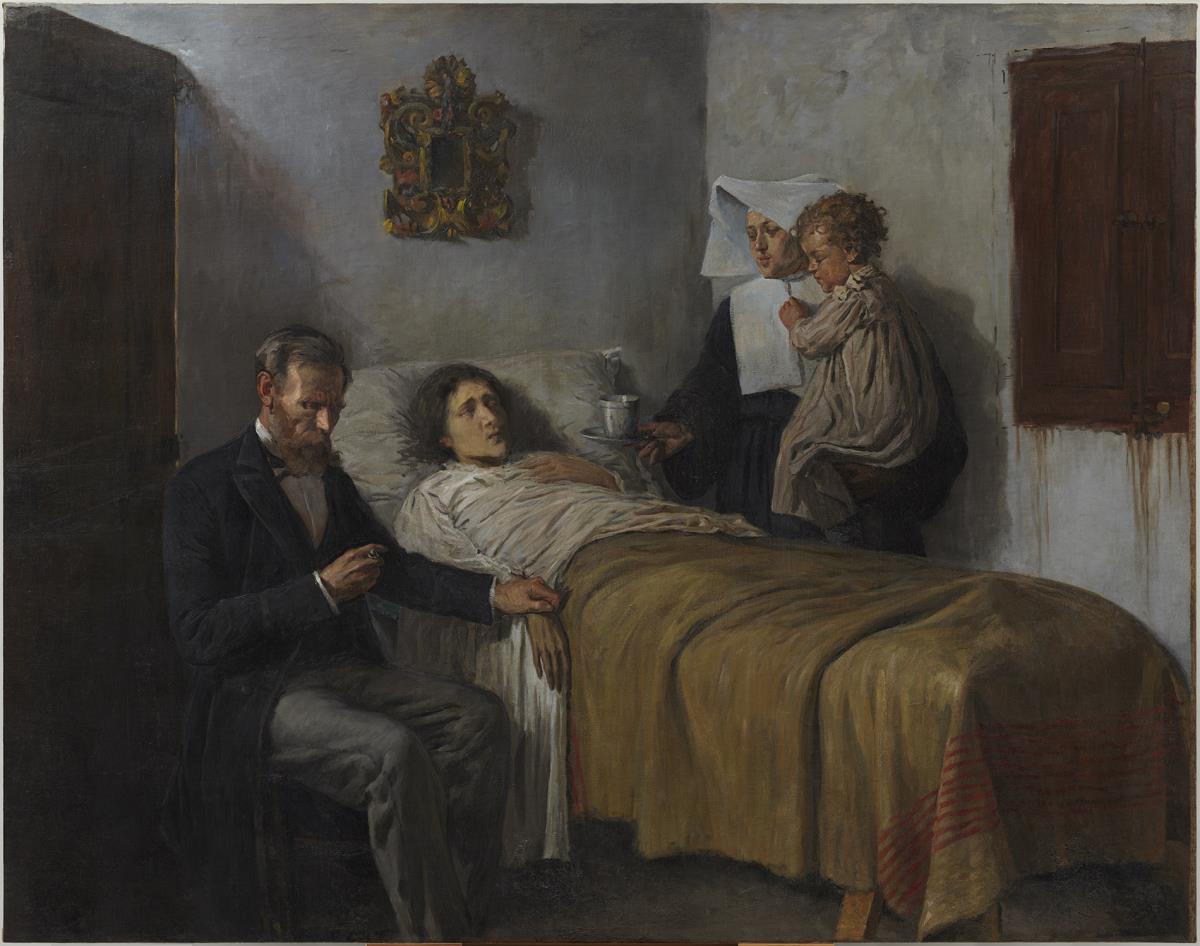
This was the reason why he painted the First Communion of
his sister, Lola, an oil painting in a larger format than he normally
used, which he worked on in the studio of his father’s friend, the
teacher José Granelo. He presented the painting at the Third Exhibition
of Fine Arts and Artistic Industries in 1896. The following year,
he repeated the experience with an even more ambitious oil painting,
Science and Charity, which he presented at the National Exhibition
of Fine Arts in Madrid, where he received an honourable mention.
The subject that he painted situated him in the mainstream of the
period. Picasso’s work became full of historical and religious themes,
and he sometimes showed a marked philanthropic spirit as well as
a great interest in scientific advances.
MALAGA,
SUMMERS OF 1896 AND 1897
The Ruiz-Picasso family spent their summers in Malaga. In 1896,
they rested for a few days at an estate in Llanes near the Malaga
mountains, the property of Pablo’s aunt and uncle, the Blasco-Alarcóns.
As a result of this stay in the country, an exhaustive account of
the surroundings of Malaga exists through a group of oil paintings,
most of them of them small and having a great descriptive freshness,
which the young man achieved thanks to a vibrant and spontaneous
brushstroke. The culmination is a larger oil painting, Paisatge
muntanyenc (Mountain Landscape), preceded by preparatory studies.
He worked on these paintings with an unrestrained, bold brushstroke,
thick with pigments, along with an absence of line; he favoured
a combination of brushstrokes of bright colours, mirroring a luminous
environment. All together, it is evident that it was his first departure
from mainstream art, and the need to affirm his own personality
appeared in his work. We should remember that Picasso had begun
some landscapes with luminous hues in Barcelona a little earlier.
This, along with the tedium and the restrictions of academic teaching,
were the determining factors for the predominance of landscapes
as a subject in his work during this period. 
Although Picasso mainly painted landscapes throughout the summer
months, we should not forget that, at that time, he was painting
the Portrait of Aunt Pepa, one of most important portraits
in the formative years of the artist.
MADRID, 1897-1898. HORTA
DE SANT JOAN, JUNE 1898 - JANUARY 1899
Picasso spends the academic year, 1897-1898, in Madrid. Encouraged
by his family, he enriched his artistic training at the San Fernando
Royal Academy of Fine Arts in Madrid, most likely advised by his
father’s colleague and friend, the teacher Antonio Muñoz Degrain.
He enrolled in classes of drawing from antiquity, drapery and landscape,
the latter taught by Muñoz Degrain himself, and he reinforced his
artistic education by attending the life drawing class that Moreno
Carbonero gave. He also frequented the Fine Arts Circle to draw
from models. Everything pointed to Pablo becoming an outstanding
artist in the Spanish artistic world. But the young man was bored
with going to classes because he was convinced that he would not
learn anything new, and he rejected the teaching methods that were
in force. 
Apart rom academic exercises during this stay in Madrid, the artistic
activity of the young Picasso was focussed on scenes of everyday
life and copying great masters of painting in the Prado Museum.
In June 1898, Picasso returned to Barcelona convalescing from scarlet
fever. A short time later, he went to stay at Horta de Sant Joan,
invited by his friend, Manuel Pallarès. For a few months -from the
end of June 1898 to January 1899- he experienced the rustic environment
of the place fully, and even managed to spend a few days in a small
cave up in the mountains. The time he spent in Horta is so important
that he mentioned it repeatedly throughout his life: “Everything
I know, I learnt in Pallarès’ village”.
The work he carried out in this period consisted of a pleasing description
of the countryside, its inhabitants and the landscape of the region.
The paintings and drawings that he worked on in Horta are a point
of reference in his artistic development because of their frank,
spontaneous and luminous character. The paintings show a new use
of colour and a great freedom of line, brushstroke and luminosity.
The youthful Picassos’s stay in Madrid marked his first serious
step towards distancing himself from academic art, and he made a
firm decision to search for new forms of artistic expression. At
Horta de Sant Joan this attitude was heightened, and his formal
rupture with the official art world became a firm stance.
BARCELONA,
1899-1900
In January 1899, Picasso returned to Barcelona after his stay in
Horta de Sant Joan. It was at this time that he became a full member
of the Catalan avant-garde. The meeting place, the heart of the
Catalan literary and artistic world, was the well-known tavern,
Els Quatre Gats, which had opened on 12 June 1897 on the Carrer
de Montsió, thanks to the initiative of Miquel Utrillo, the collaboration
of Rusiñol and the economic support of Casas and the businessmen,
Girona and Ardèniz. The person in charge was Pere Romeu. The young
Picasso’s fellow participants in the discussions and activities
were Carles Casagemas, Jaume Sabartés, Ramon and Cinto Reventós,
Mateu and Àngel Fernández de Soto, Joaquim Mir, Hermen Anglada Camarasa,
Isidre Nonell, Ramon Pichot, and others. 
This was the time Picasso left home and went to live in a studio
he shared with the Cardona i Furró brothers.
The influence of Catalan Modernisme is quite obvious in the artist’s
work. Nordic tendencies and a marked anti-realist air dominated
the cultural outlook in the city. Schopenhauer, Nietzsche, Wagner...
were the idols of philosophers, writers, artists, musicians ...
, and of the Catalan society in general at the end of the nineteenth
century and well into the twentieth.
Their writings were read in the magazines of the period, like Catalunya
Artística, Pèl & Ploma and Joventut. Their music was played
in all the opera seasons in the city.
Picasso’s 1899 and 1900 work was dominated by the human figure,
especially by the portraits of his friends, which were shown in
the exhibition room of Els Quatre Gats in February 1900, the first
individual exhibition of the artist. Despite this, he did not stop
painting street scenes or the urban landscapes that he liked so
much; he introduced a subject that he would come back to in other
stages of his life: landscapes seen from a window. 
His open-minded spirit, eager for new experiences, meant that he
could not help trying out the new means of graphic expression that
were all the rage at the end of the nineteenth century: poster designing.
The young man took part by preparing drawings for several poster
competitions. In the summer of 1900, he also started to work on
newspaper illustrations, which reached its high point the following
winter in Madrid, when he created the journal Arte Joven with Francesc
d’Assís Soler, where he was the artistic director of the first five
issues.
PARIS,
1900 AND 1901
In the autumn of 1900, Picasso, accompanied by Casagemas, travelled
to Paris for the first time. His work Last Moments had been chosen
to form part of the Universal Exhibition that had opened on 14 April.
This, and the fact that the French capital was the artistic Mecca
at that time made him decide to go there and stay for a few months.
Years later, Sabartés, Picasso’s friend and secretary, would say,
“This idea of going to Paris was like an illness that was causing
havoc among us”. The two young men found a place in Montmartre:
a studio that had belonged to the painter, Isidre Nonell.

This stay enabled him to experience at first hand the European artistic
avant-garde that he had heard so much about from the Catalan Modernistes,
and which he had been able to enjoy through reproductions. This
direct contact would soon bear fruit. Apart from the rich artistic
scene in the city, he enjoyed everything with which he came into
contact. Captivated by scenes on the street and by the nightlife,
his work was full of passers-by, of lovers embracing on the boulevards,
and of elegant men and women going in and out of places of entertainment.
Scenes of Parisian life were abundant, and along with them came
views of architecture or nature that then became a setting for human
activity.
In December, the young men returned to Barcelona for Christmas,
and afterwards, they travelled to Malaga to celebrate New Year’s
Eve. A short time later, Picasso went to Madrid, where he stayed
until the following spring. In February 1901, his friend Carles
Casagemas committed suicide in Paris. In June, Picasso returned
to Barcelona before leaving on his second trip to Paris. This time
he was accompanied by Jaume Andreu Bonsoms. 
In the French capital, Pere Mañach, his first art dealer, organised
an exhibition for him and the Basque painter, Iturrino, at the Galerie
Vollard.
His work from this period is characterised by the sharp division
of the brushstroke and the exuberant colour. His new freedom in
using colour gave life to a fresh artistic interpretation, very
close to the work of the Fauvists, although Picasso never came to
use the exaggerated colours that they did. The Fauvists coupled
the feeling of deforming reality in a composition through colour,
thus overcoming the fleeting effect of light that the Impressionists
used by turning colour into an expressive medium in itself. Work
done by Picasso in this period was markedly influenced by Toulouse-Lautrec,
although it was not centred so much on the elegant design formed
by lines as by the figures themselves, which held more interest
for him. He painted in oil, applying a big, loose, individualised
brushstroke, contrasting colours, which has been called “macrodivisionism”,
and which gave his work the texture of a mosaic.
THE
BLUE PERIOD
From the autumn of 1901 to the end of January 1904, Picasso’s work
underwent a radical change in colour and subject matter, at the
same time that the figures show some formal mutations that are characteristic
of his first personal period: the Blue Period. 
A series of personal, social and cultural factors in his milieu
were a determining factor in his move from worldly subjects to subjects
of a marked symbolic character. At that time, the artist was under
the influence of the philosophic doctrines from the north of Europe,
which were well known in the Catalonia of the Modernista period.
Another determining factor was his friendship with the poet, Max
Jacob. From him, he was introduced to the French symbolist literature
of Baudelaire, Rimbaud and especially Verlaine. Picasso believed
that art sprang from sadness and pain; it had a dramatic mission,
and was a source of emotion, rather than pleasure. This, and the
influence of the German Expressionists were decisive in his work.
The suicide of his friend, Casagemas was another factor that would
play an important role at the beginning of this period.
The change to this new style was not sudden; on the contrary, it
came about gradually. He was immersed in his new style at the end
of autumn in 1901 in Paris, and he continued working in this way
during the following years, whether living in the French capital
or in Barcelona.
There are drawings of great expressiveness from the Blue Period
that supplant the quick spontaneous sketches of former times: faces
marked by poignant grief, lengthened figures in the El Greco manner,
despondent figures weighed down by their own misfortune, starving
men and women with passive, apathetic expressions, often in the
midst of large empty spaces. This Picasso universe is dominated
by one colour: blue, a colour having psychological implications,
and which impregnates all his canvases, and is introduced into some
drawings. Even the portraits of his friends or urban landscapes
do not escape the narcotising effect of blue.
THE
ROSE PERIOD, 1905
Picasso’s pictorial universe took another substantial turn in 1905.
Like the earlier period, it came about gradually. Picasso’s new
figures are circus acrobats and other circus performers.
In this period, Picasso lived in the Parisian quarter of Montmartre.
The Medrano circus set up nearby was a place he frequented with
his Catalan friends: Ricard Canals, Manolo Hugué and the poets Max
Jacob, André Salmon and Guillaume Apollinaire. The entertainment
world had interested him since he was very young. The circus as
a theme was part of a strong artistic tradition, inherited from
Degas and Toulouse-Lautrec, although Picasso was bolder than his
admired predecessors had been.
As figures in his painting, women become ever present. In a group
or alone, they are the centre of the composition of a good part
of the drawings and oil paintings done in this period, which is
dominated by pinkish or iridescent colours. The figures have lost
the psychological burdens that they used to be weighed down with
and the scenes are almost set decorations that allow the newcomers
to be shown in movement. Their ‘incorporeal’ bodies seem freer,
more delicate, even though they are standing still.
The Portrait of Señora Canals is a magnificent example from
this period. Picasso made good use of his friend, the painter and
engraver Ricard Canals, who had done an oil painting of a box at
the bullring in which his wife, Benedetta Bianco and Fernande Olivier,
Picasso’s companion, were seated. Picasso profited by his friend’s
work in order to paint the portrait of the beautiful Roman, a portrait
dominated by the sweet and melancholy atmosphere typical of his
work during this period.
BARCELONA,
1917
The process of searching for new ways of expression in the plastic
arts, begun by Picasso in 1906, would result in a change from a
perceptive method to a conceptual one.
The new artistic experiences that he had tackled before his stay
in Gósol in the summer of 1906 bore fruit in this hamlet in the
Alt Berguedà with its bare landscapes and ochre and grey soil.
The influence of Cézanne and Ingres, Iberian art and art from Africa
merge in Picasso’s work, reinforcing the simplification of shapes
and monumentality, and by eliminating what is not indispensable.
He then began a process of simplifying, geometrizing and schematising
the shapes, in the predominant reddish-ochre tones. The objectivity,
the serenity and the equilibrium of his work set the foundations
for his immediate artistic future. The process begun at Gósol continued
with Les Demoiselles d’Avignon and was consolidated with Cubism.

Cubism was a new artistic form that Pablo Picasso and Georges Braque
invented in 1908 and practised intensely until the First World War.
This new style brought the artistic postulates that had dominated
the art world since the Renaissance into question and set the foundations
of a new artistic practice that would revolutionise the artistic
world in our century. Between 1909 i 1912, what is known as Analytic
Cubism was developed. This was based on the juxtaposition of light
and dark planes, the fragmentation of images and the extremely subdued
colours of ochre, beige, grey and brown. From 1910 on, the geometric
structures were so hermetic that they reached a point where they
became almost abstract. The artists then put in hints to help the
viewer interpret their work. The introduction of papier collé in
1912 marked a new direction in this artistic movement. At that time,
Braque and Picasso worked on their compositions creating objects
by grouping elements to facilitate their interpretation. Between
1912 and 1914, they introduced other material onto the canvas, which
provided new textures. This Cubism was totally different from, and
at the same time, a consequence of the former, and is known as Synthetic
Cubism. Later, Cubism was enriched by new, more aesthetic than conceptual
contributions, by reincorporating the colour that was missing during
the years of chromatic austerity.
In 1917, Picasso spent time in Barcelona. A few months before, he
had begun to work with Serge Diaghilev’s Ballets Russes along with
the poet, Jean Cocteau, who were in Rome then to prepare the ballet
Parade. There he met Olga, one of the Russian ballet dancers who
was a member of the troupe and to whom he would marry the following
year. The company stayed in the Ranzini pension, on the Passeig
de Colom, near to Picasso’s home. The Picasso Museum possesses a
group of works from that time which shows the variety of styles
that the artist then painted in.

His work from this period is rich and varied. He combined the search
for new sources of inspiration with experiments in new methods of
painting. This is a time of transition in which he worked in several
stylistic procedures as a means of investigating new ways of expression:
along with a series of Cubist work -a late Cubism in which the shapes
have softened and colour has reappeared- he painted Harlequin,a
clear exponent of his return to the classic manner that he had used
some time before. Expressionism also made an appearance in this
period of great creative intensity with Gored Horse, a clear
forerunner of Guernica. Another work, Woman with Mantilla,
shows his mastery of the divisionist technique.
1917-1957
The museum has few paintings and drawings from this period.
Between 1924 and 1925 he continued his investigation with still
lifes, which show a growing interest in abstraction. At this time,
the surrealists decided on a renovation of aesthetics, in which
the world of dreams and the subconscious mind had a primary role.
Although Picasso was not a member of this group, he played an important
part in encouraging this movement.

During the 1940s, he kept on painting still lifes, but in comparison
with the ductile lines of the 1920s, they present an acute geometric
structure and are very strident in colour.
Sabartés was a privileged witness to the artistic development of
Picasso. As his friend and his personal secretary from 1935 until
his death in 1968, he experienced Picasso’s creative activity -which
always had a strong autobiographical component- intensely. Thus,
it is not strange that the faithful and discreet friend was a motif
in some of his work. Picasso made a painting and some drawings of
him where he is disguised in very unlikely ways: as a gentleman
of the Spanish Golden Age, as monk or a faun.
LAS MENINAS, 1957
Between August and December 1957, Picasso analyses Las Meninas
(The Maids of Honour) by Velázquez in depth.

From the time of his adolescence, Picasso adored Velázquez, whom
he copied at the Prado Museum. He had then shown interest in Las
Meninas, an unequivocal masterpiece that has been defined as
a veritable theology of painting. The painting/mirror, painting/trompe
d’oeil, and the playing with reflections, encompassed all the ingredients
to fascinate a Picasso who was becoming a painter of painting. For
years he felt a crucial need to confront the work of other artists,
and he considered that the painting of his admired predecessors
was a motif to paint like any other subject. This is the reason
why he devoted himself voraciously to analysing and interpreting
the work of artists like Grünewald, El Greco, Delacroix, Courbet,
Manet.... and Velázquez.
Between 1954 and 1962 he seemed to be possessed by a frenetic desire
to scrutinise their work, an activity that would lead him to create
a veritable laboratory in order to study and interpret three masterpieces:
Algerian Women at Home by Delacroix, Las Meninas by
Velázquez and Le déjeuner sur l'herbe (Luncheon on the Grass)
by Manet, which caused an unprecedented development in the interpretation
of the plastic arts. Between August and December in 1957, he shut
himself in the studio of his house, La Californie near Cannes, to
face the challenge of Las Meninas. One unique piece of work is the
origin of fifty-eight oil paintings: forty-four inspired in the
model, nine little pigeons, three landscapes and two free interpretations.
A whole series in which he plays with exterior and pictorial reality,
art and life, to include views from the exterior into the series
of paintings. At that time, Picasso was not trying to paint a unique
piece, a masterpiece. What he really wanted was to systemise a group
of canvases that had a common theme. Each piece of work is a link
in the whole chain and whole is the main protagonist. The artist
himself said that what he was really interested in was the movement
of painting, the dramatic force of one approach or another, even
though this force did not appear until he had finished them all.
He was attracted more to the development of his thinking than the
thoughts in themselves
These paintings served to make of an exhaustive study of form, rhythm,
colour and movement. An imaginative game without limits, in which
the figures were metamorphosed without varying the perceived space,
volume and original light in any way.
He began the depiction on a large canvas of the group in a grisaille,
which repeated the composition of the original, although he changed
the vertical format for the horizontal and modified the large closed
windows of Velázquez’ work by having them wide open, since Picasso
considered that light was the most important thing.
Las Meninas is a big interior scene: a portrait of a studio,
of a spacious room with large windows -surely the one in Alcàsser
in Madrid, where the artist from Seville worked. Picasso captured
-as did Velázquez- the atmosphere and the naturalness of the scene
taking place before him in the spacious palace chamber with sublime
perfection. He always maintained the attitude of the master of the
Spanish Golden Age, which unites the immediate truth of the unexpected
visit with intellectual mystery.
The characters do not vary. Picasso even keeps the two main trios:
Velázquez, Doña Agustina de Sarmiento, Doña Margarita; Doña Isabel
de Velasco, Maribárbola and Nicolasito Pertusato, he also reproduces
the shape of the seated dog. He keeps the looking-glass that he
recreates in other paraphrases: the optical and emblematic values
that were used to advantage as much by Velázquez as by painters
from the Netherlands. The big difference between Velázquez’ painting
and Picasso’s is in its aesthetics.
PICASSO
ENGRAVER
The Picasso Museum in Barcelona possesses a relevant collection
of engravings and lithographs by the artist, consisting of some
1,500 prints.
Some are from a donation by Jaume
Sabartés [click here for a brief biography], one of the
people responsible for the existence of our museum. Picasso himself
donated an important part of the collection when he paid tribute
to Sabartés at the time of the latter’s death, and promised to donate
a print of every engraving he made from then to the end of his life.
The rest of the engravings are donations from other benefactors
and work that the museum has acquired over the years. 
The pieces that make up the collection are also a vivid testimony
to the close relationship of the artist with printers as important
as Eugène Delâtre, Louis Fort, Roger Lacourière, Aldo and Piero
Crommelyck, Mourlot and Arnéra. He established rewarding working
relations with each of them. The dialogue between engraver and printer
resulted in one of the most important legacies in the history of
graphic arts.
Picasso’s first foray into this field took place in 1899, when he
made an engraving of a picador on a metal sheet. We do not know
whether it was his inexperience or his intention for the man holding
the lance to be left-handed, the reason that the title is El zurdo,
or the left-handed man. Whatever the reason, the important thing
is that the perseverance of the creative genius of Picasso made
him keep on improving his engravings until he became one of the
great engravers in the history of art.
The museum collection of engravings starts with The Frugal Meal
(1904), which would mark the real beginning of his activity
in this field. It is an etching that the artist made in Paris, assisted
by the Catalan painter and engraver, Ricard Canals. As much for
its subject matter as for its aesthetics, it is included in his
Blue Period. 
From this time until his death, Picasso explored the different engraving
techniques with voracity: wood engraving, etching, aquatint, dry-point,
lithography, silkscreen printing, etc.
There are four etchings from the Cubist period made in 1911 in Cadaqués
to illustrate Saint Matorel written in 1910 by the poet,
Max Jacob, which was published by his art dealer D.H. Kahnweiler
and printed by Delâtre.
During the 1920s, the subject matter and the aesthetics of his engravings
run parallel to his paintings. The museum collection includes groups
of dry-point prints and etchings that have varied themes: maternity,
portraits of Olga, still lifes, bathers, heads of men and women...
In 1931, the Swiss publisher, Albert Skira, published The Metamorphoses
by Ovid with the printer, Louis Fort, illustrated with 30 etchings,
of which the museum has one that Salvador Dalí donated in 1963.
Another outstanding series of prints was compiled and published
by his art dealer, Ambroise Vollard, in 1939, and known as the Suite
Vollard. It is a set of 100 works, basically etchings, dry-points,
and aquatints. The Picasso Museum has around thirty of them that
he made between 1930 and 1937.
The Minotaur is one of the major figures in the SuiteVollard
and one of Picasso’s most outstanding engravings, another The
Minotauromachy, is one of the best in the twentieth century.
On 8 January 1937, Picasso made two etchings, Sueño (Dream)
and Mentira de Franco (Franco's Lie), to collect money for
the Spanish Republic. By means of a series of vignettes, he tells
the story of the exploits of an evil character having a grotesque
aspect. A series of crying women follows, like the figure in one
of the vignettes in one of the etchings, that depicts her enormous
grief for the magnitude of the tragedy.
After the Second World War, lithography was the technique used most
by Picasso for a time. The museum collection exhibits a variety
of subjects that interested him during these years. However, the
most emblematic of the figures in this period of pacification was
the dove, which became the main figure in some of these lithographs.
We are reminded of the one chosen by the poet, Aragon, for the poster
of the first Peace Conference that was held in Paris in 1949.
At that time, he also undertook an intense activity as a book illustrator.
There is a good selection of these in the museum: Deux contes
(1947), by Ramon Reventós; Vingt poèmes (1948), by Luís de
Góngora y Argote; À haute flamme (1955), by Tristan Tzara;
Dans l’atelier de Picasso (1957) and Les Menines et la
vie (1958), by Jaume Sabartés; Sable mouvant (1966),
by Pierre Reverdy; El entierro del conde Orgaz (1969), by
Pablo Picasso. Apart from the prints, the museum has the cancelled
copper plates and a copy of the book by Picasso.
Picasso worked intensely on linocuts in the years from 1954 to 1964.
He met the printer Arnéra in Vallauris, with whom he began fruitful
conversations that resulted in the making and printing of 200 linocuts;
seventy of them are displayed in the museum.
Between 1957 and 1959, he made some on the art of bullfighting:
a set of 27 aquatints to illustrate the book La Tauromaquia
o Arte de torear (Tauromachy or the Art of Bullfighting)
by José Delgado, known by the name of Pepe Illo. The museum has
the prints made from the cancelled plates, as well as the cancelled
plates without the text.
The last years in the life of the artist are notable for two numerous
sets of engravings. These are the sets of 347 and 156 engravings,
which are the thematic and iconographic culmination of his creative
years. The first set was done between 16 March and 5 October 1968,
and he presented an entire print run to the museum between December
1968 and September 1971. The second set was printed by the Crommelynck
brothers. The Picasso family donated it in 1989 through the Louise
Leiris Gallery (one print is missing). Along with this, his family
also donated two aquatints: the 1949 Venus i Cupido segons Cranach
el Jove (Venus and Cupid According to Cranach the Younger) and
the Portrait of Angela Rosengart (1966).
In 1983, Picasso’s heirs and Louise Leiris presented the city of
Barcelona with 117 prints from his period in the classic manner,
the period of his link with surrealism and his Mediterranean period,
thus respecting the wishes of the artist. It is a beautiful group
through which one can see the great variety of techniques that he
mastered: etching, aquatint, mezzotint, dry-point, lithography and
the use of the burin.
PICASSO
CERAMIST
Picasso was introduced to the world of ceramics by chance. In the
summer of 1944, he and his companion Françoise Gilot went to stay
in Golfe-Juan, on the Côte d'Azur. They went on an outing one day
to the village of Vallauris, where they met the Ramiés, a married
couple who were the owners of the prestigious Madoura pottery workshop.
The potters invited them to visit their workshop. Picasso modelled
a few pieces and became captivated by this technique that is so
rooted in the Mediterranean culture. The following year, he returned
with some ideas to put into practice. This was the beginning of
an adventure that lasted until the end of his life and left a profuse
collection of ceramics, bearing witness to his passion for this
art.. 
Suzanne Ramié, an expert ceramist, introduced him to this world.
She taught him to work with the white Vallauris clay. She taught
him how to use the manufactured enamels that already existed at
that time, and to fire the pieces in electric kilns at a temperature
of 1,100º. Helped by potters who prepared the clay for him, and
by pottery painters who helped him with the enamel, he worked on
his freely-drawn individual designs on numerous pieces as uninhibited
as ever: flat pieces, pitchers, bottles, small earthenware jars,
bowls, tiles... In a few cases, he was even bold enough to manipulate
the pieces, distorting them to increase their expressiveness and
to change their equilibrium. He often adapted the decoration to
a shape, but at other times, he did not shy away from changing a
shape to fit the motifs. His subjects were the usual ones: the mythological
world of fauns and satyrs, animals, –especially doves and goats,
bullfighting, human figures... Picasso distanced himself from the
decorative tradition in ceramics, and he created his own tradition,
as he did in painting.